It depends on your plan type. If you have a private or marketplace plan, you can generally cancel at any time. But if you have employer-sponsored insurance, you typically can only cancel during Open Enrollment or after a qualifying life event. Canceling mid-year without a backup plan can leave you with a costly coverage gap.
1. Cancellation Rules by Plan Type
Health insurance in the United States is not one-size-fits-all, and neither are the rules for canceling it. The answer to “can you cancel health insurance at any time?” depends entirely on who provides your coverage and what kind of plan you have.
Here is a quick overview of the four main plan types and how cancellation works for each one:
Employer-Sponsored
RestrictedCan only cancel during Open Enrollment or after a qualifying life event. Mid-year cancellations are rarely allowed.
ACA Marketplace
More FlexibleCan be canceled at any time through HealthCare.gov or your state exchange. Coverage ends on a date you choose.
Private / Off-Exchange
FlexibleCancel directly with the insurer. Usually allowed anytime, sometimes with a notice period of 30 days.
Medicaid / CHIP
Voluntary DisenrollYou can voluntarily disenroll, but Medicaid automatically ends if your income exceeds eligibility limits.
2. Canceling Employer-Sponsored Insurance
Employer-sponsored health insurance is the most common type of coverage in the U.S., and it has the strictest cancellation rules. Under federal law and most employer plan designs, you cannot simply walk up to HR and cancel your coverage on a random Tuesday in July.
When Can You Cancel?
There are two main windows during which you can make changes — including canceling — an employer-based plan:
Annual Open Enrollment Period
Once per year, your employer opens a window (typically 2–4 weeks) during which you can enroll, change, or drop coverage. Most employer plans run on a calendar year, so Open Enrollment usually happens in October or November for coverage starting January 1.
Qualifying Life Event (Special Enrollment)
Outside Open Enrollment, you can typically make changes within 30–60 days of a qualifying event. Common qualifying events include: marriage or divorce, birth or adoption of a child, loss of coverage from another source, death of a dependent, moving to a new coverage area, or change in employment status.
If you cancel employer-sponsored insurance outside of these windows without a qualifying event, your employer may not allow you to re-enroll until the next Open Enrollment period — potentially leaving you uninsured for months.
Can Your Employer Cancel Your Insurance?
Yes — an employer can discontinue or change health benefits, typically with advance notice. They can also terminate your coverage if you leave the job, reduce hours below the eligibility threshold, or fail to pay your premium share. In those cases, COBRA continuation coverage gives you the right to keep your plan for up to 18 months (at full cost).
3. Canceling ACA Marketplace Plans
If your health insurance comes from the ACA marketplace (HealthCare.gov or a state exchange like Covered California), you have considerably more flexibility when it comes to cancellation.
Yes — You Can Cancel Anytime
Marketplace plans can be canceled at any time of year. There is no restriction on when you can drop coverage. You simply log into your marketplace account and request a plan termination, choosing either an immediate end date or a future date.
If you cancel a marketplace plan mid-year because you gained other coverage (like a new job’s employer plan), this is a qualifying life event that also opens a Special Enrollment Period at your new insurer.
What Happens to Your Subsidies?
If you receive a premium tax credit (subsidy) to help pay for your marketplace plan, canceling mid-year has tax implications. You will need to reconcile the subsidy when you file your federal taxes. If you received more subsidy than you were entitled to (because you did not have coverage for the full year), you may have to repay a portion of it.
How to Cancel a Marketplace Plan
Log in to HealthCare.gov (or your state exchange)
Go to your account dashboard and find your current enrollment.
Select “Terminate Coverage”
Look for options labeled “Cancel My Plan,” “Terminate,” or “End Coverage.”
Choose Your End Date
Select the date you want coverage to end. This can be the same day or a future date.
Confirm and Save
Review your cancellation and confirm. You should receive a confirmation email from the marketplace.
Notify Your Insurer Directly (Optional but Recommended)
Contact your insurance company directly to confirm the cancellation has been processed and no further premiums will be charged.
4. Canceling Private or Direct-Purchase Plans
If you bought your health insurance directly from an insurer — outside the ACA marketplace — cancellation is generally straightforward. Most private insurers allow you to cancel at any time, though the specific process varies by company.
What to Expect
You typically call the insurer’s customer service line, submit a written cancellation request, or cancel through an online member portal. Some insurers require 30 days’ written notice, while others process same-day cancellations. Always ask for written confirmation and check whether you are owed a prorated refund for any prepaid premiums.
Before canceling a direct-purchase plan, check whether you qualify for marketplace coverage. If you do, you may be able to get the same or better coverage at a lower cost with ACA subsidies — especially if your income is between 100% and 400% of the federal poverty level.
5. Canceling Medicaid or CHIP
Medicaid and the Children’s Health Insurance Program (CHIP) are government programs, and their cancellation rules are a bit different from commercial plans.
Voluntary Disenrollment
You can choose to disenroll from Medicaid at any time by contacting your state Medicaid agency. This is called voluntary disenrollment. You may want to do this if you have gained private insurance and prefer that coverage, or if you no longer want to use the program.
Automatic Loss of Eligibility
More commonly, Medicaid coverage ends automatically when your income rises above the eligibility threshold, when you move out of the state, or when you fail to complete the annual renewal process. States conduct annual redeterminations to verify your eligibility, and if you no longer qualify, your coverage is terminated.
Do not cancel Medicaid until your new coverage is confirmed and active. There can be processing delays, and a gap — even a few days — could leave you unprotected for medical bills.
6. What Happens When You Cancel Health Insurance?
Canceling health insurance is not something to take lightly. The consequences can extend far beyond simply losing your doctor visits and prescription coverage.
| Consequence | Details | Severity |
|---|---|---|
| Loss of Coverage | You immediately lose access to your insurer’s negotiated rates. Uninsured patients often pay 2–5× more for the same services. | High |
| Coverage Gap | Any medical event during the gap is fully your financial responsibility. Even a short ER visit can cost $3,000–$20,000+. | Very High |
| Re-enrollment Restrictions | For employer plans, you may have to wait until the next Open Enrollment (months away) to re-enroll. | High |
| Subsidy Repayment | If you cancel a marketplace plan after receiving advance premium tax credits, you may need to repay some of those credits at tax time. | Moderate |
| State Tax Penalty | Some states fine residents for going uninsured. Penalties can range from $695 to several thousand dollars per year. | Moderate |
| Impact on Ongoing Treatments | Canceling mid-treatment may interrupt prescriptions, therapy, or specialist care. New insurers may also consider pre-existing conditions. | High |
7. State Penalties for Being Uninsured
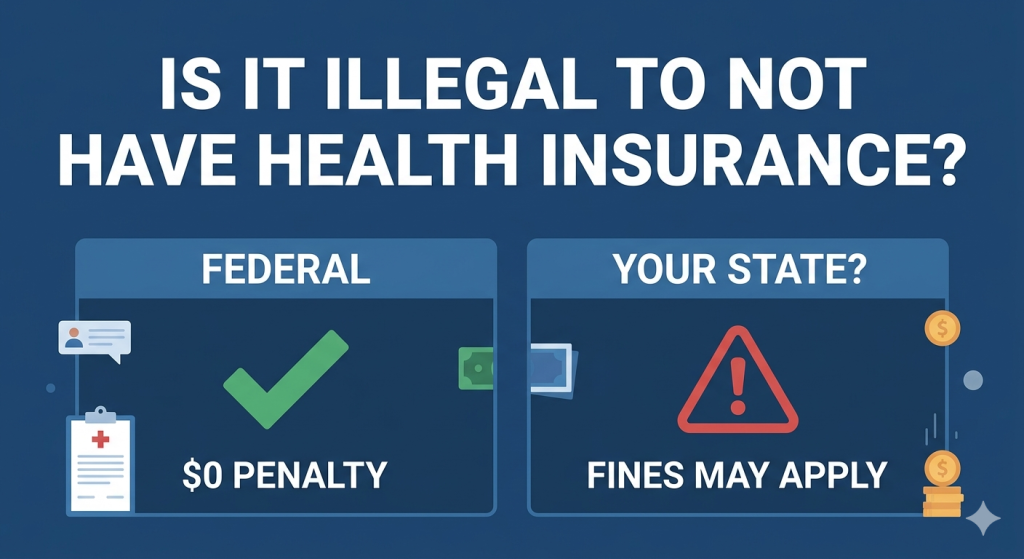
The federal individual mandate penalty was effectively eliminated in 2019 when the ACA’s penalty was reduced to $0. However, several states still enforce their own individual mandates, meaning you could owe a penalty on your state tax return if you are uninsured for part of the year.
8. What to Do Before You Cancel
Before you pull the trigger on canceling your health insurance, work through this checklist. A few minutes of preparation can save you from thousands of dollars in unexpected medical bills.
- Confirm your replacement coverage is active and the effective date is confirmed in writing.
- Finish any pending procedures, tests, referrals, or specialist visits while you still have coverage.
- Refill long-term prescriptions to ensure you have an adequate supply during any transition period.
- Check whether you have hit your deductible for the year — canceling now means losing that progress with a new insurer.
- Verify whether you owe any outstanding premium payments to avoid being sent to collections.
- If you receive ACA subsidies, calculate your potential repayment obligation before canceling early in the year.
- If you live in CA, MA, NJ, DC, or RI, count the months uninsured to estimate your state penalty.
- Ask your new insurer about pre-existing condition coverage rules and waiting periods.
- Request written cancellation confirmation and keep it for your records and tax purposes.
9. How to Cancel Health Insurance — By Plan Type
The exact process for canceling health insurance depends on where your coverage comes from. Here is a step-by-step breakdown for each major scenario:
🏢 Employer Plan
Contact HR or Benefits Administrator
Reach out to your HR department and ask about the process for dropping coverage. Confirm whether you qualify for a mid-year cancellation.
Provide Documentation of Qualifying Event (if applicable)
Submit proof of your qualifying life event — such as a marriage certificate, birth certificate, or proof of new coverage.
Complete Required Paperwork
Fill out any forms required by your employer or benefits platform (such as Workday, BenefitFocus, or ADP).
Confirm Your Termination Date in Writing
Get written confirmation of when your coverage ends and keep this for your records.
🛒 ACA Marketplace Plan
Log in to HealthCare.gov or Your State Exchange
Access your account and navigate to your current plan enrollment.
Select “Cancel” or “Terminate Plan”
Follow the on-screen prompts to end your coverage.
Choose Your End Date
You may be able to end coverage immediately or on a specific future date.
Call the Marketplace Helpline if Needed
If you cannot cancel online, call 1-800-318-2596 (HealthCare.gov) for assistance.
📋 Private / Direct-Purchase Plan
Call Your Insurer’s Member Services Line
The number is on your insurance card. Ask specifically about the cancellation process and any notice period required.
Submit a Written Cancellation Request if Required
Some insurers require a signed letter or email. Ask whether you need to submit anything in writing.
Ask About Prorated Refunds
If you prepaid premiums, ask whether you are owed a refund for the unused portion.
Quick Reference: Cancellation Rules at a Glance
| Plan Type | Can Cancel Anytime? | Notice Required? | Re-enrollment Restriction? | COBRA Available? |
|---|---|---|---|---|
| Employer-Sponsored | Usually No | Varies by employer | Yes — Next Open Enrollment | Yes |
| ACA Marketplace | Yes | None required | Only OEP applies | No |
| Private / Off-Exchange | Yes | Sometimes 30 days | No restriction | No |
| Medicaid | Yes (voluntary) | Varies by state | Re-apply when eligible | No |
| Medicare | Limited | Varies | Restrictions apply | No |
| Short-Term Plans | Yes | None or 30 days | No restriction | No |
Frequently Asked Questions
Need Help Understanding Your Health Insurance Options?
Explore more health insurance guides on FlipACoinOnline to make smarter coverage decisions.
Explore More Guides →