When the Affordable Care Act (ACA) was signed into law in 2010, it included an individual mandate — a legal requirement for most Americans to maintain “minimum essential coverage.” People who went without insurance faced a federal tax penalty each year.
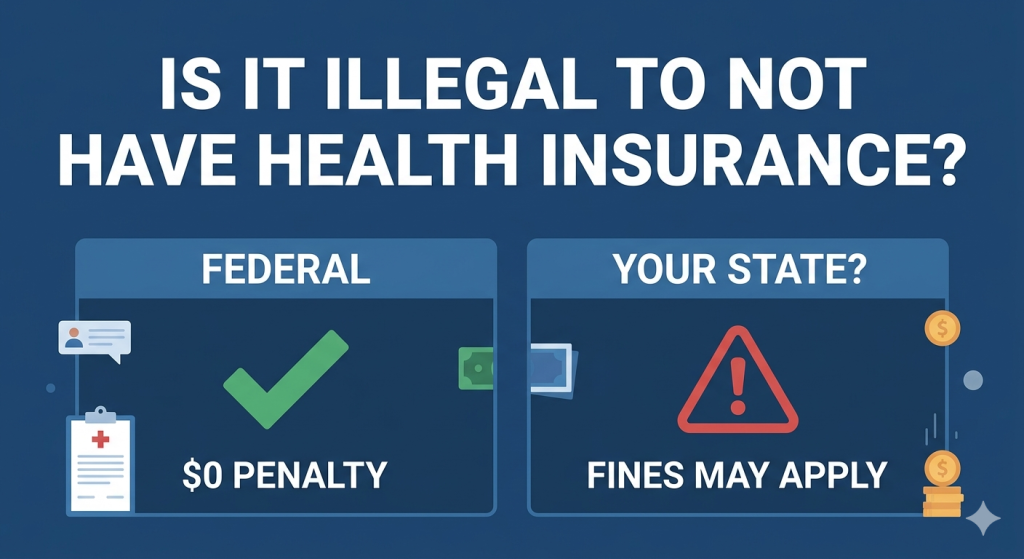
That changed dramatically in 2017. The Tax Cuts and Jobs Act of 2017 reduced the federal individual mandate penalty to $0 starting January 1, 2019. So while the legal language requiring coverage technically still exists in the ACA, there is no financial consequence for ignoring it at the federal level.
✅
Federal Penalty: $0 Since 2019
The IRS no longer charges a penalty for being uninsured. You don’t need to report or justify your lack of coverage on your federal tax return.
2010
ACA Signed Into LawThe individual mandate takes effect. Americans must carry minimum essential coverage or pay a federal penalty.
2014
Penalties BeginThe penalty starts at $95/adult or 1% of income (whichever is higher) and increases each subsequent year.
2016
Maximum Federal PenaltyThe penalty peaks at $695/adult or 2.5% of household income above the tax filing threshold — whichever is greater.
2019
Federal Penalty Reduced to $0The Tax Cuts and Jobs Act eliminates the federal fine. States begin creating their own individual mandates to fill the gap.
2025
Today: Federal = No Penalty. Some States = Real Fines.Six states plus Washington D.C. now enforce active insurance mandates with financial penalties.
States That Still Require Health Insurance
After the federal penalty was eliminated, several states took matters into their own hands. As of 2025, the following jurisdictions have their own individual health insurance mandates:
🏛️ Federal vs. State Mandates — Side by Side
Federal (All 50 States)
No Active Penalty
$0 Fine
The ACA individual mandate still exists in text, but the penalty was zeroed out in 2019. No enforcement, no reporting requirement.
State Level
Active Mandates in 6 States + D.C.
Real Fines Apply
California, Massachusetts, New Jersey, Rhode Island, Vermont, Washington State (limited), and D.C. all enforce their own penalty structures.
When Penalty Applies (Federal)
Never
No Action Needed
The IRS does not assess or collect any penalty. No Form 1040 reporting is required for lack of coverage.
When Penalty Applies (State)
At State Tax Filing
Due Annually
Penalties are calculated and collected when you file your state income tax return. Amounts vary by state, income, and family size.
If you live in any of the states listed below and do not have qualifying health coverage for the year, you will owe a penalty when you file your state taxes.
State Penalty Amounts Explained
Each state calculates the penalty differently. Most use a combination of a flat per-person fee and a percentage of income, charging whichever is higher.
State / D.C.
Mandate Active?
Penalty Per Adult
Penalty Per Child
Income-Based Option
California
Active
$900/year
$450/year
2.5% of household income above filing threshold (whichever is higher)
Massachusetts
Active
Up to ~$2,240/year
Varies
50% of the lowest-cost available plan premium; varies by income
New Jersey
Active
$735–$2,085/year
$367.50/year
2.5% of household income (whichever is higher)
Rhode Island
Active
$695/year
$347.50/year
2.5% of income above filing threshold
Vermont
Active (no fine)
No financial penalty
No financial penalty
Mandate exists but currently no financial enforcement
Washington D.C.
Active
$745/year
$372.50/year
2.5% of household income (whichever is higher)
All Other States
No Mandate
$0
$0
No state-level penalty applies
⚠️
Important Note on Massachusetts
Massachusetts has had an individual mandate since 2006 — predating the ACA. Its penalty structure is the most complex of any state and is tied to affordability thresholds. Residents earning under 150% of the Federal Poverty Level (FPL) are typically exempt from the penalty.
Who Is Exempt from the Mandate?
Even in states with active mandates, not everyone is required to have insurance. Both federal guidelines (for historical reference) and state-level rules recognize a range of exemptions that can reduce or eliminate your penalty.
💰
Financial HardshipIf the lowest-cost available plan exceeds a set percentage of your income, you may qualify for a hardship exemption.
🏠
Below Filing ThresholdIf your income is below the IRS tax filing threshold, you are generally exempt from any insurance penalty.
📿
Religious BeliefsMembers of certain recognized religious sects that object to insurance as a matter of faith may qualify for an exemption.
🏕️
HomelessnessIndividuals experiencing homelessness are typically exempt from state insurance mandates.
🌍
Short Coverage GapA gap in coverage of less than 3 consecutive months in a year typically does not trigger a penalty in most states.
🚫
IncarcerationIndividuals who are incarcerated for the full year are generally not penalized for lacking health coverage.
🌐
Non-Citizen/Non-ResidentIndividuals who are not lawfully present or who are out of the country for most of the year may be exempt.
✝️
Health Sharing MinistriesMembers of certain health care sharing ministries may qualify as having coverage under state exemption rules.
ℹ️
How to Claim an Exemption
In states with a mandate, exemptions are generally claimed when you file your state tax return. Keep documentation of your situation (income records, letters, etc.) in case you’re asked to substantiate the exemption.
Real Consequences of Being Uninsured
Even where there is no legal penalty, going without health insurance carries serious financial and health risks. The legal question is only one piece of the picture.
⚠️ Risks of Going Without Health Insurance
🏥
Catastrophic Medical BillsA single hospital stay can cost $30,000–$100,000+. Without insurance, you’re liable for the full amount.
💊
No Access to Negotiated RatesInsurers negotiate discounted rates with providers. Uninsured patients are often billed at the full, highest price.
🦷
Deferred Preventive CareWithout coverage, many people skip routine checkups and screenings, allowing treatable conditions to worsen.
📉
Impact on Credit ScoreUnpaid medical bills can go to collections and damage your credit score for years.
🚑
Emergency Room as Primary CareWithout a regular doctor, uninsured people often use ERs for non-emergency care — the most expensive option.
🔒
State Tax PenaltyIf you live in CA, MA, NJ, RI, or D.C., you’ll face a real fine at tax time — potentially $700–$2,000+ per person.
Your Options if You Can’t Afford Coverage
Not having coverage is often a financial decision, not a preference. If cost is the barrier, there are several programs and options that can help:
1. Medicaid
If your income is below roughly 138% of the Federal Poverty Level (about $20,780/year for a single adult in 2025 in expansion states), you may qualify for Medicaid — a government health program with very low or no premiums. Eligibility varies by state. Check healthcare.gov to find out if you qualify.
2. ACA Marketplace Plans with Subsidies
Even if you don’t qualify for Medicaid, you may be eligible for premium tax credits (subsidies) through the ACA Marketplace if your income is between 100% and 400% of the FPL — or higher under current enhanced subsidies. These credits can significantly reduce your monthly premium.
3. CHIP (Children’s Health Insurance Program)
If you have children, they may qualify for CHIP even if you don’t qualify for Medicaid yourself. CHIP covers children in families with modest incomes at low or no cost.
4. Short-Term Health Insurance
Short-term health insurance plans offer limited coverage for a temporary period. They are generally cheaper but do not meet ACA minimum essential coverage standards, meaning they may not exempt you from state penalties.
5. Open Enrollment and Special Enrollment Periods
The ACA Marketplace has an annual Open Enrollment Period (OEP) typically from November 1 to January 15. Outside of this window, you can enroll during a Special Enrollment Period (SEP) if you’ve had a qualifying life event such as losing a job, getting married, or having a baby.
💡
Free Help Is Available
Navigators and certified application counselors are available at no cost to help you compare and enroll in ACA plans. Visit localhelp.healthcare.gov to find free assistance near you.
⭐ Bottom Line
Being uninsured is not a federal crime and carries no federal penalty as of 2019. But if you live in California, Massachusetts, New Jersey, Rhode Island, or Washington D.C., you could face a state-level tax penalty of several hundred to several thousand dollars per person. More importantly, going without health insurance carries serious financial risk that no legal exemption will protect you from. Exploring ACA subsidies, Medicaid, or CHIP could make coverage more affordable than you think.
Frequently Asked Questions
At the federal level, no — there is no longer a penalty for being uninsured. The federal individual mandate penalty was reduced to $0 starting in 2019. However, California, Massachusetts, New Jersey, Rhode Island, and Washington D.C. have their own mandates with real financial penalties that apply when you file your state taxes.
As of 2025, states with individual health insurance mandates include California, Massachusetts, New Jersey, Rhode Island, Vermont (mandate but no fine), and Washington D.C. Each has its own penalty structure — see the table above for specific amounts.
In California, the penalty is 2.5% of your household income above the filing threshold OR a flat dollar amount per uninsured person — whichever is higher. For 2024 taxes, the flat rate is $900 per adult and $450 per child, with a family maximum of $2,700. The penalty is assessed when you file your California state tax return.
Yes. States with individual mandates offer exemptions for situations like financial hardship (where the cheapest plan costs more than a set percentage of income), homelessness, recent domestic violence, religious beliefs, short coverage gaps under 3 months, and others. Exemptions are typically claimed on your state tax return.
Under the federal Emergency Medical Treatment and Labor Act (EMTALA), hospitals with emergency departments must provide stabilizing care regardless of ability to pay. However, you will receive a bill for the full cost of treatment. Without insurance, you are billed at the uninsured rate — which is often significantly higher than the negotiated rates insurance companies pay. A single ER visit can cost $2,000–$30,000 or more.
The ACA’s individual mandate language still technically exists in federal law, but the financial penalty for non-compliance was reduced to $0 by the Tax Cuts and Jobs Act of 2017, effective January 1, 2019. So while the law is “still there,” there is nothing to enforce it at the federal level. The Supreme Court upheld the ACA in 2021, but with the $0 penalty it had no practical enforcement mechanism.
Under the ACA’s employer mandate, employers with 50 or more full-time equivalent employees (called “Applicable Large Employers” or ALEs) are required to offer affordable, minimum-value health coverage to full-time workers or potentially face a federal tax penalty. This is separate from any individual mandate and still applies regardless of the $0 individual penalty.
Yes, in certain cases. If you experience a qualifying life event — such as losing job-based coverage, getting married or divorced, having a baby, or moving to a new coverage area — you qualify for a Special Enrollment Period (SEP) that allows you to enroll outside the standard Open Enrollment Period. Medicaid and CHIP enrollment is available year-round for those who qualify.
📌 This article is for informational purposes only. Health insurance rules, penalties, and exemptions can change. For personalized guidance, consult a licensed insurance broker or visit healthcare.gov.