There is no single “perfect” deductible — it depends on your health, budget, and risk tolerance. That said, for most healthy Americans in 2025, a deductible of $500 to $1,500 for individual coverage offers a reasonable middle ground between affordable monthly premiums and manageable out-of-pocket exposure. The national average employer-sponsored deductible is $1,886 for a single employee. Read on to find what number makes sense for you.
When you shop for health insurance, you face a dizzying array of numbers — premiums, copays, coinsurance, out-of-pocket maximums, and of course, deductibles. Of all of these, the deductible is often the one that catches people off guard. You sign up, assume you have coverage, then get hit with a $2,000 bill before your insurance pays a cent.
The question most people have is straightforward: What is a good deductible for health insurance? The honest answer is that the right deductible is different for a 28-year-old marathon runner than it is for a 54-year-old managing type 2 diabetes. This guide walks you through the real numbers, the trade-offs, and the decision framework to land on the right amount for your situation.
What Is a Health Insurance Deductible?
Before deciding what a good deductible looks like, it helps to understand exactly what a deductible does. Your deductible is the dollar amount you must pay out of your own pocket for covered medical services before your insurance plan begins paying its share.
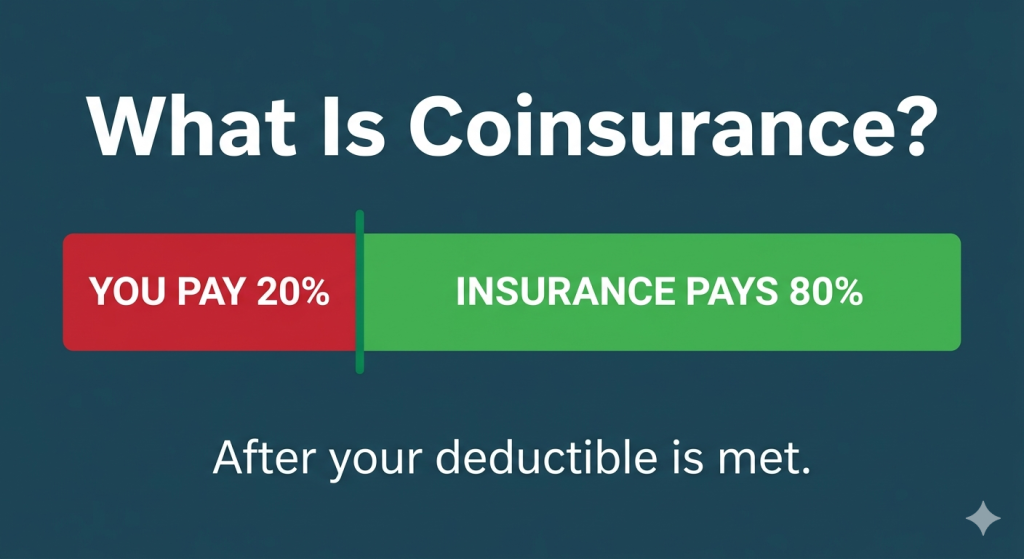
For example, if your plan has a $2,000 deductible, you will pay the first $2,000 of covered expenses yourself each plan year. Once you hit that threshold, your insurer steps in — typically covering a percentage of additional costs through coinsurance, until you hit your out-of-pocket maximum, after which the insurer pays 100%.
One important exception: under the Affordable Care Act, all non-grandfathered major medical plans must cover certain preventive services at no cost — meaning those services are free even if you have not yet met your deductible. These include annual wellness exams, blood pressure screenings, vaccinations, and many cancer screenings.
Average Deductible Amounts in 2025
Understanding what most Americans actually pay helps calibrate expectations. Deductibles vary significantly based on whether you get insurance through an employer, the ACA Marketplace, or a private insurer — and which metal tier you choose.
| Coverage Source / Plan Type | Avg. Individual Deductible (2025–2026) | Level |
|---|---|---|
| Employer-Sponsored (Large Company) | ~$1,670 | Moderate |
| Employer-Sponsored (Small Company) | ~$2,631 | High |
| ACA Marketplace — Bronze Plan | ~$7,476 | Very High |
| ACA Marketplace — Silver Plan | ~$5,304 (without CSR) | High |
| ACA Marketplace — Gold Plan | $1,000–$1,500 (typical range) | Moderate |
| ACA Marketplace — Platinum Plan | $0–$500 (typical range) | Low |
| IRS HDHP Minimum (2025) | $1,650 individual / $3,300 family | High |
These figures make it clear: if you buy a Bronze plan on the Marketplace, you may be looking at a deductible approaching or exceeding $7,000 before your insurer shares significant costs. A Gold or Platinum plan costs more per month but dramatically reduces what you owe when you actually need care.
High vs. Low Deductible: The Core Trade-Off
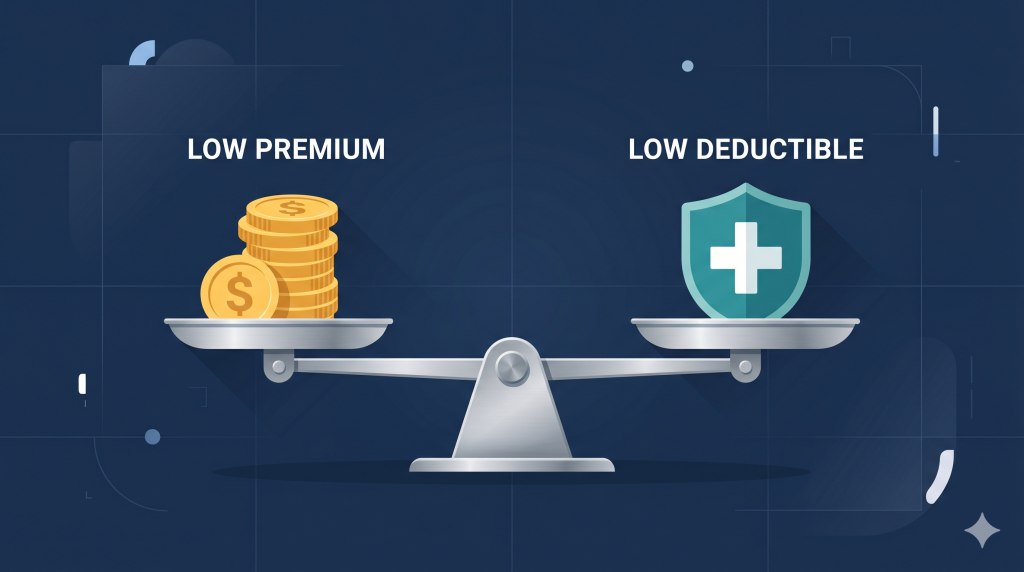
Every deductible decision comes down to one fundamental question: Do you want to pay more every month, or pay more when you get sick? Neither answer is wrong — they reflect different financial situations and risk tolerances.
What Counts as a “High” Deductible in 2025?
The IRS officially defines a High-Deductible Health Plan (HDHP) as any plan with a minimum deductible of $1,650 for self-only coverage or $3,300 for family coverage in 2025. Out-of-pocket expenses (including the deductible) cannot exceed $8,300 for individuals or $16,600 for families. For 2026, the HDHP deductible threshold rises slightly — to $1,700 for individuals and $3,400 for families.
This IRS definition matters because only qualified HDHPs make you eligible to open and contribute to a Health Savings Account (HSA) — a powerful tax-advantaged tool that can offset the sting of a high deductible.
The HSA Factor: How a High Deductible Can Actually Save You Money
A key reason many Americans choose a high-deductible plan is access to a Health Savings Account (HSA). An HSA lets you set aside pre-tax dollars specifically to pay medical expenses — including your deductible. The money grows tax-free and unused funds roll over indefinitely, unlike a Flexible Spending Account (FSA).
📥 2025 HSA Contribution Limits
- Individual coverage: $4,300
- Family coverage: $8,550
- Age 55+ catch-up: additional $1,000
- Deadline to contribute: April 15, 2026
🎯 Triple Tax Advantage
- Contributions are tax-deductible
- Money grows tax-free
- Withdrawals for qualified expenses are tax-free
- No income limit to qualify
Who Should Choose a High-Deductible Plan?
A High-Deductible Plan May Be Right For You If…
- You are generally healthy and rarely visit the doctor beyond annual checkups
- You can afford to pay your full deductible if an unexpected medical event occurs
- You want lower monthly premium payments to free up cash flow
- You want to open and grow an HSA for tax advantages and future savings
- You are self-employed and need to keep monthly costs low
- Your employer contributes to your HSA, offsetting the higher deductible
A Low-Deductible Plan May Be Right For You If…
- You have a chronic illness or ongoing medical condition requiring frequent care
- You take multiple regular prescriptions each month
- You have children or other family members who frequently need medical attention
- You prefer predictable, manageable bills rather than large unexpected costs
- You do not have an emergency fund large enough to cover a $3,000+ deductible
- You are pregnant or planning to become pregnant in the plan year
What Is a Good Deductible? A Range-Based Answer
Rather than a single number, it helps to think in ranges based on different health profiles. Here is how to interpret common deductible brackets in 2025:
| Deductible Range | What It Means | Best Suited For |
|---|---|---|
| $0 – $500 | Very low; insurer pays quickly. Premiums will be high (Gold/Platinum tier). | Frequent care users; families with young children; managing chronic illness |
| $500 – $1,500 | Moderate. Good balance of premium and out-of-pocket exposure. Below national average. | Most working adults; moderate healthcare users; people without large savings |
| $1,500 – $3,000 | Above average for employer plans. Near or at HDHP threshold. May be HSA-eligible. | Healthy adults with an emergency fund; HSA savers; employer-sponsored HDHP holders |
| $3,000 – $6,000 | High. Common in Bronze/Marketplace plans. Significant financial exposure if illness strikes. | Young, healthy individuals who want minimal premiums; those with robust HSA funds |
| $6,000+ | Very high. Common in Bronze Marketplace plans. Only justifiable with substantial HSA savings. | Rarely recommended unless premiums are near-zero and you have strong financial reserves |
How to Choose the Right Deductible: A Step-by-Step Process
Estimate Your Annual Healthcare Usage
Look back at the past 12 months. How many doctor visits did you have? Did you fill any prescriptions regularly? Did you have any procedures, tests, or specialist visits? The more care you typically use, the more a low deductible will pay off.
Calculate Your Annualized Premium Difference
Compare plans with different deductibles and look at the premium gap. Multiply the monthly premium difference by 12. If a high-deductible plan saves you $1,800/year in premiums, you are breaking even only if you spend that $1,800 on medical care before your deductible. If you spend less, the HDHP wins.
Check Your Emergency Financial Cushion
Can you cover your full deductible right now without going into debt? If your plan has a $4,000 deductible and you have $800 in savings, a sudden injury or illness becomes a financial crisis. Make sure your savings or HSA can realistically cover your worst-case deductible scenario.
Factor In the Out-of-Pocket Maximum
The deductible is not your total exposure — it is just the starting point. Look at the plan’s out-of-pocket maximum as your true worst-case annual cost. For 2025, the ACA cap on out-of-pocket maximums is $9,450 for individuals and $18,900 for families on Marketplace plans.
Consider Whether You Qualify for Cost-Sharing Reductions
If your income is between 100% and 250% of the federal poverty level, you may qualify for cost-sharing reductions (CSRs) on Silver Marketplace plans. CSRs dramatically lower the effective deductible — sometimes to $200–$500 — making Silver plans an outstanding value for eligible individuals.
Open an HSA If You Choose an HDHP
If you go with a qualified high-deductible plan, open an HSA immediately and start contributing. Even small monthly contributions build a tax-free cushion that reduces the actual sting of your high deductible over time.
Individual vs. Family Deductibles: An Important Distinction
If you are covering a family on your health plan, understand that most plans have two types of deductibles: an individual deductible and a family deductible.
👤 Individual Deductible
Each family member must meet their own individual deductible before the plan starts paying for their care. For example, with a $1,500 individual deductible, each person is responsible for the first $1,500 of their own covered costs.
👨👩👧 Family Deductible
Once the family’s combined out-of-pocket spending across all members hits the family deductible (e.g., $4,000), the plan starts covering costs for all family members — even those who have not met their individual deductibles yet.
For a family of four, choosing a plan with a high family deductible can be particularly risky, since multiple people may incur medical costs simultaneously. Families with children or anyone with regular healthcare needs typically benefit more from a lower-deductible plan, where the insurer starts sharing costs sooner across all family members.
Watch Out for Separate Prescription Drug Deductibles
Many health insurance plans have not one, but two deductibles: one for medical services and a separate one for prescription drugs. This means even after meeting your medical deductible, you may still owe the full cost of prescriptions until a second, separate deductible is satisfied.
If you take regular medications, always check whether your plan has a combined or separate drug deductible. A plan with a seemingly low $1,000 medical deductible but a separate $500 drug deductible may cost more than a plan with a single $1,200 combined deductible, depending on your prescriptions.
Is a $0 Deductible Worth It?
Some health plans — typically Platinum-tier Marketplace plans or premium employer-sponsored plans — offer a $0 deductible. This means your insurer begins sharing costs from your very first covered medical service, with no waiting period.
A zero-deductible plan sounds ideal, but the monthly premium is substantially higher. Whether it is worth it depends entirely on how much care you use. For someone who visits specialists frequently, fills multiple prescriptions, or undergoes regular procedures, a $0 deductible plan can result in lower total annual spending despite the higher premium. For a healthy person who only uses a yearly checkup, that high premium is mostly wasted.
Deductible vs. Premium: Running the Math
The most reliable way to find a “good” deductible is to compare the total annual cost of each plan option — not just one number in isolation. Here is a simple framework:
The example above illustrates the classic break-even point. Both hypothetical plans cost roughly the same at around $5,000 in annual care usage. Below that threshold, the high-deductible plan wins on total cost. Above it, the low-deductible plan starts to save money despite its higher premium.
Frequently Asked Questions
A “good” deductible depends entirely on your health profile, financial situation, and how much medical care you expect to use. For most healthy adults, a deductible between $500 and $1,500 for individual coverage offers a solid balance. The national average for employer-sponsored individual coverage in 2025 is $1,886. If your plan offers cost-sharing reductions (for lower incomes on Silver Marketplace plans), your effective deductible could drop well below that.
The IRS defines an HDHP (High-Deductible Health Plan) as a plan with a deductible of at least $1,650 for self-only coverage or $3,300 for family coverage in 2025. Only plans meeting these thresholds qualify for Health Savings Accounts (HSAs). Many Bronze Marketplace plans have deductibles of $5,000–$8,000, which are well into “very high” territory.
Yes — a $1,000 individual deductible is considered below average and generally favorable for most Americans. It means your insurance starts sharing costs after you pay the first $1,000. You will typically pay a higher monthly premium for a plan with this level of deductible, but many people find the predictability and lower out-of-pocket exposure worth it.
A $5,000 deductible is high and carries real financial risk. It is manageable only if you have at least $5,000 in savings or an adequately funded HSA to cover an unexpected medical event. If you cannot absorb a $5,000 medical bill without going into debt, this level of deductible is not advisable — regardless of the premium savings. That said, for a young, healthy person who only uses preventive care and has strong savings, a $5,000 deductible with a low premium can be a financially sound choice.
Generally, no. Your deductible is tied to your specific health plan, and you cannot change it mid-year without switching plans. Switching plans is only allowed during your annual Open Enrollment period or a Special Enrollment Period triggered by a qualifying life event (such as losing job-based coverage, getting married, or having a baby). If you switch plans mid-year, your deductible typically resets to zero with the new plan — you do not carry over progress toward your deductible from the old plan.
No. You can only contribute to an HSA if you are enrolled in a qualified High-Deductible Health Plan (HDHP) that meets IRS deductible minimums. For 2025, those minimums are $1,650 for individual coverage and $3,300 for family coverage. If you switch to a non-HDHP, you cannot make new contributions — but you can keep and use existing HSA funds for qualified medical expenses at any time, forever.
Yes. Health insurance deductibles reset at the start of each new plan year — typically January 1 for most plans. This means any progress you made toward meeting your deductible does not carry into the next year. Some insurers offer a “deductible carryover credit” if you switch plans within the same insurer near year-end, but this is uncommon. If your plan year starts in January and you have an elective procedure or predictable expensive care coming up, it is often worth timing it to get the most from your already-met deductible before the year resets.
Your deductible is what you pay before your insurance begins sharing costs. Your out-of-pocket maximum is the absolute most you will ever pay in a single plan year for covered in-network services — after which your insurer covers 100%. The deductible counts toward the out-of-pocket maximum, but so do copays and coinsurance. For ACA Marketplace plans in 2025, the maximum out-of-pocket limit is $9,450 for individuals and $18,900 for families.
Still Comparing Plans?
Use our free tools on FlipACoinOnline to help you think through health insurance decisions, compare cost scenarios, and understand what coverage terms really mean for your budget.
Explore Our Free Tools →