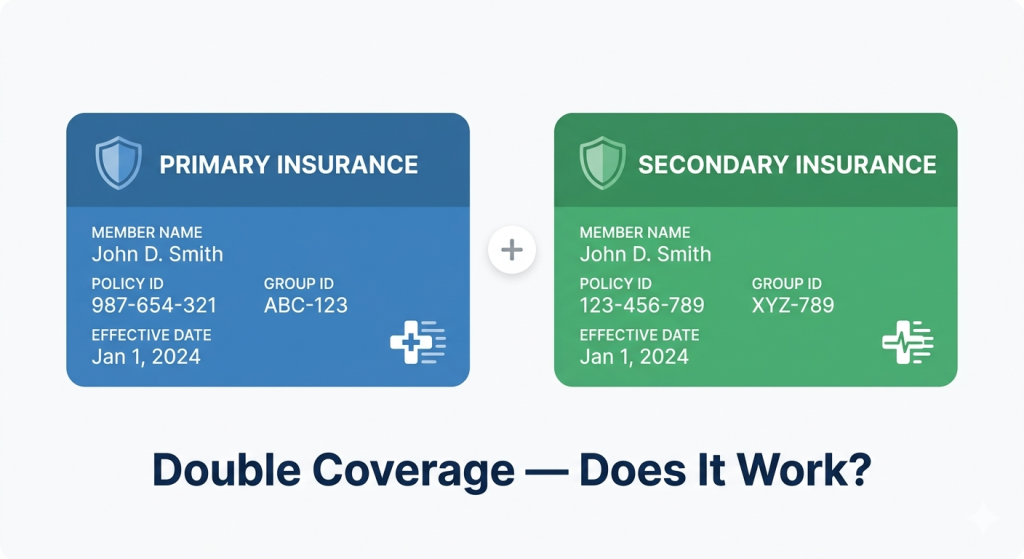
Yes — you can absolutely have two health insurance plans at the same time. This is called dual coverage or double coverage, and it is completely legal in the United States. But having two plans does not mean you get double the money back. There are specific rules that govern how both plans work together — and understanding them can save you thousands of dollars every year.
What Does It Mean to Have Two Health Insurances?
Having two health insurance plans means you are enrolled in two separate health plans simultaneously. Both plans contribute toward covering your medical expenses, but they do so in a coordinated way — not independently.
One plan is designated as your primary insurance and the other as your secondary insurance. When you receive medical care:
- Your primary insurance processes the claim first and pays its portion according to its own terms — deductibles, copays, and coverage limits.
- After the primary insurer pays, the remaining balance (if any) is sent to your secondary insurance, which then covers some or all of what is left.
- Any amount still remaining after both plans have paid is your out-of-pocket responsibility.
Important: Insurance companies do not allow you to make a profit from a claim. The combined payment from both plans cannot exceed the total cost of the medical service you received.
Is It Legal to Have Two Health Insurance Plans?
Yes, it is completely legal. There is no law in the United States that prevents a person from enrolling in two health insurance plans. Employers, government programs, and private insurers all allow this. Many people end up with dual coverage without even realizing it — for example, when both spouses have employer-sponsored plans and each adds the other to their coverage.
Who Commonly Has Two Health Insurance Plans?
Dual coverage is more common than most people think. Here are the most frequent situations where someone ends up with two health insurance plans:
1. Married Couples With Employer Plans
When both spouses work and both have employer-sponsored health insurance, they may choose to add each other to their respective plans. This creates a situation where both people have dual coverage — their own employer’s plan as primary and their spouse’s employer’s plan as secondary.
2. Children Covered Under Both Parents’ Plans
Children are one of the most common cases of dual coverage. When both parents have separate health insurance plans, a child can be added to both. A special rule called the birthday rule is used to determine which parent’s plan acts as primary (more on this below).
3. People on Medicare and a Private Plan
Retirees who are 65 and older often have Medicare as well as a supplemental plan (Medigap), or they may still be covered under a former employer’s retiree health plan. In many cases, Medicare acts as the secondary payer when the person has other coverage.
4. People With Medicaid and Employer Insurance
Some low-income individuals qualify for Medicaid but are also enrolled in an employer-sponsored plan. In these cases, the private employer plan typically pays first, and Medicaid acts as the payer of last resort.
5. Young Adults on Parents’ and Employer Plans
Under the Affordable Care Act, young adults can stay on their parents’ health insurance until age 26. If such a person also receives health insurance through their own employer, they will have two plans — typically their employer plan as primary and their parents’ plan as secondary.
6. Athletes or High-Risk Professionals
Some people in professions with elevated injury risk purchase supplemental health insurance on top of their primary plan to reduce their out-of-pocket exposure for costly medical events.
How Coordination of Benefits (COB) Works
Coordination of Benefits (COB) is the set of rules insurance companies follow to decide which plan pays first and how much each plan pays when a person has two health plans. Every insurer that offers group or individual coverage has COB rules, and they are required by law in most states.
| Situation | Primary Plan | Secondary Plan |
|---|---|---|
| You have your own employer plan + spouse’s employer plan | Your own employer’s plan | Spouse’s employer’s plan |
| Child covered by both parents’ plans | Plan of parent with earlier birthday in the year (Birthday Rule) | Plan of parent with later birthday |
| Active employee with Medicare | Employer’s group health plan | Medicare |
| Retired person with Medicare + retiree plan | Medicare | Retiree health plan |
| Person with Medicaid + employer plan | Employer’s plan | Medicaid (payer of last resort) |
| Person on COBRA + new employer plan | New employer’s plan | COBRA plan |
The Birthday Rule Explained
The birthday rule is one of the most commonly misunderstood concepts in dual health insurance coverage. It applies specifically when a child is covered under both parents’ health insurance plans.
Here is how it works:
- The plan of the parent whose birthday falls earlier in the calendar year (month and day — not year) is considered the primary plan for the child.
- The plan of the parent whose birthday falls later in the calendar year is the secondary plan.
- The parent’s age does not matter — only the month and day of their birthday counts.
Example: Parent A has a birthday on March 5. Parent B has a birthday on September 14. Even if Parent B is younger, Parent A’s plan is primary for the child because March comes before September in the calendar year.
If both parents share the same birthday (month and day), most insurers fall back to alphabetical order by first name, or use the plan that has been in effect the longest as primary.
In the case of divorced parents, the birthday rule may not apply. Instead, a court order or divorce decree may specify which parent’s plan is primary. If no court order exists, the plan of the custodial parent is typically primary.
Can Dual Coverage Give You 100% Coverage?
In many situations, yes — dual coverage can eliminate your out-of-pocket costs entirely. Here is a simplified example of how this can work:
| Step | Who Pays | Amount |
|---|---|---|
| Total medical bill | — | $1,000 |
| Primary insurance pays (80% after deductible) | Primary Plan | $800 |
| Remaining balance sent to secondary | — | $200 |
| Secondary insurance pays remaining balance | Secondary Plan | $200 |
| Your out-of-pocket cost | You | $0 |
However, this does not always happen. The secondary plan has its own rules, and it may not cover everything the primary plan did not. The amount the secondary plan pays depends on its own deductibles, coverage rules, and COB methodology.
Pros and Cons of Having Two Health Insurance Plans
✅ Pros
- Lower or zero out-of-pocket costs for medical care
- Better coverage for high-cost medical events like surgery or hospitalization
- Prescription drug costs may be significantly reduced
- Peace of mind knowing you have an extra layer of coverage
- Useful for families with children who need frequent medical care
- Can cover services that one plan excludes but the other covers
❌ Cons
- Two premiums can be expensive if you pay for both yourself
- Administrative complexity — filing claims with two insurers takes time
- Risk of claim delays if coordination between insurers is slow
- Not all secondary plans cover the gaps left by primary plans
- Some secondary plans use non-duplication rules, limiting their benefit
- Managing two deductibles and two out-of-pocket maximums can be confusing
How to File a Claim With Two Health Insurance Plans
Filing claims when you have dual coverage is a bit more involved than with a single plan. Follow these steps to make the process as smooth as possible:
- Always inform your healthcare provider that you have two insurance plans. Give them both insurance cards at the time of your visit. Most providers will handle the billing for both plans directly.
- Your provider submits the claim to your primary insurer first. The primary plan processes it and sends an Explanation of Benefits (EOB) detailing what it paid and what remains.
- The remaining balance (along with the primary insurer’s EOB) is then sent to your secondary insurer. The secondary plan reviews the claim and pays according to its own rules.
- After both insurers have processed the claim, you receive an EOB from each. Review them carefully to understand what was paid, what was denied, and what — if anything — you owe.
- If there is still an outstanding balance, pay only after both plans have fully processed the claim. Paying too early can complicate reimbursements.
Does Having Two Health Plans Save You Money?
The answer depends entirely on your personal situation. For people who frequently use medical services — such as those managing chronic conditions, families with young children, or individuals recovering from surgery — dual coverage can produce significant savings by covering deductibles, copays, and coinsurance that would otherwise come out of pocket.
However, if you are generally healthy and rarely use medical services, the cost of paying a second premium may outweigh the benefits. You need to do the math based on your specific plans, premium costs, and how often you expect to use healthcare.
Quick tip: If your secondary insurance is provided through your employer at little or no cost to you, it almost always makes sense to keep it — even if you rarely use it. Free or low-cost secondary coverage is usually worth having.
Can You Have Two Private Health Insurance Plans?
Yes. You can hold two entirely private (non-government) health insurance plans simultaneously. This might happen if, for example, you purchase a plan through the ACA marketplace and also have a plan through your employer, or if you purchase an individual plan in addition to your employer-sponsored coverage.
In all cases, the same COB rules apply. The plan that has been in effect longest is generally considered primary when two private plans do not have a clear employer-based priority.
Medicare and Dual Coverage
Medicare has specific rules about how it coordinates with other insurance:
- If you are actively employed and covered by your employer’s group health plan, that employer plan pays first and Medicare pays second — regardless of whether Medicare is Part A or Part B.
- If you are retired and have Medicare plus a retiree health plan from a former employer, Medicare typically pays first and the retiree plan pays second.
- If you have Medicare and Medicaid, Medicare pays first and Medicaid covers any remaining eligible costs as the payer of last resort.
- If you have Medicare and a Medigap plan, Medicare pays first and Medigap covers the gaps (like deductibles and coinsurance) that Medicare leaves behind.
Things to Consider Before Getting a Second Health Insurance Plan
Before enrolling in a second plan, ask yourself these questions:
- What will the second premium cost me? If it is expensive, run the numbers to make sure the coverage benefit justifies the cost.
- Which COB method does the secondary plan use? Some plans use the “maintenance of benefits” method (pays full difference), while others use the “non-duplication” method (pays nothing if primary already paid its full share).
- Does the secondary plan cover services my primary plan does not? Complementary coverage can be very valuable.
- Are my doctors in-network for both plans? If one plan is an HMO with a narrow network, having a second plan may not help if your providers are already covered by your primary.
- Will the administrative burden be manageable? Dual coverage means dealing with two insurers, two EOBs, and potentially longer claim resolution times.
Key Takeaways
- Having two health insurance plans is legal and relatively common in the United States.
- One plan is always designated as primary and pays first; the other is secondary and covers remaining costs.
- Coordination of Benefits (COB) rules govern exactly how both plans work together.
- The birthday rule determines which parent’s plan is primary when a child is covered by both parents.
- Dual coverage can reduce or eliminate your out-of-pocket costs — but combined payments can never exceed total medical costs.
- Always tell your healthcare provider you have two plans and give them both insurance cards at every visit.
- Whether dual coverage is worth it depends on your premium costs, health needs, and how often you use medical services.