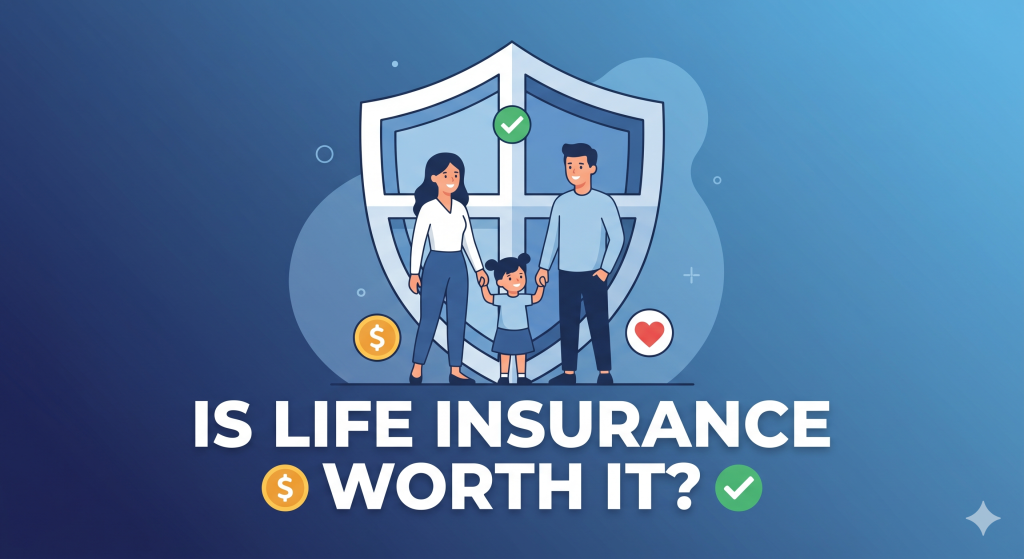
For most people with dependents, a mortgage, or significant debt, yes — life insurance is absolutely worth it. A healthy 30-year-old can get $500,000 of 20-year term coverage for around $26 a month. The question isn’t really whether life insurance is worth it in general — it’s whether it’s worth it for you. This guide gives you a straight answer based on your actual situation.
Life insurance is one of those purchases that feels abstract until the moment it becomes devastatingly real. You pay premiums for years, probably never use the policy, and you might start wondering: is this just money going down a drain?
The honest answer is that it depends entirely on who you are, what you owe, and who depends on you. Life insurance is one of the most valuable financial products ever created — for the people who need it. For those who don’t, it can be an unnecessary expense. This guide helps you figure out which category you fall into, with real data, real numbers, and zero sales pressure.
What Does Life Insurance Actually Do?
Before deciding if it’s worth it, it helps to be precise about what life insurance actually accomplishes. At its core, life insurance does exactly one thing: it replaces your economic value to the people who depend on you, if you die while they still need you.
When you pay your monthly premium, you are transferring one specific financial risk — the risk of dying too soon — to an insurance company. If that event occurs, your insurer pays your beneficiaries a tax-free lump sum called the death benefit. They can use that money to pay the mortgage, cover daily expenses, fund college tuition, or simply maintain the life you worked to build for them.
Life insurance is not an investment in the traditional sense. It does not make you money. It does not grow your wealth. It protects wealth — or more precisely, it protects the people who depend on the income that creates wealth. That distinction matters when deciding if a policy is “worth it” for your particular life.
The Real Cost of Life Insurance in 2025
One of the biggest reasons people skip life insurance is cost — or rather, the perception of cost. According to a 2025 LIMRA survey, healthy young adults overestimated the price of a $250,000 term policy by 10 to 12 times. The reality is far more affordable than most people imagine.
| Age | $500K / 20-Yr Term (Male) | $500K / 20-Yr Term (Female) | $1M / 20-Yr Term (Male) | $1M / 20-Yr Term (Female) |
|---|---|---|---|---|
| Age 25 | ~$18/mo | ~$15/mo | ~$32/mo | ~$26/mo |
| Age 30 | ~$26/mo | ~$21/mo | ~$46/mo | ~$37/mo |
| Age 35 | ~$34/mo | ~$28/mo | ~$62/mo | ~$49/mo |
| Age 40 | ~$48/mo | ~$37/mo | ~$90/mo | ~$68/mo |
| Age 45 | ~$80/mo | ~$60/mo | ~$152/mo | ~$112/mo |
| Age 50 | ~$130/mo | ~$95/mo | ~$249/mo | ~$183/mo |
At $26 per month for $500,000 in coverage, a 30-year-old is paying less than most gym memberships to protect half a million dollars of financial security for their family. Even at age 40, the $48 monthly premium is a remarkably small price relative to the protection it buys.
When Life Insurance Is Absolutely Worth It
Life insurance provides the clearest value — and is most obviously “worth it” — in these specific situations:
You Have Dependents
- Children, especially young ones, depend entirely on your income
- A spouse or partner would face financial hardship without you
- Aging parents rely on your financial support
- Anyone whose lifestyle would collapse without your income
You Have a Mortgage or Major Debt
- Your family could lose the home without your income to pay the mortgage
- Co-signed private student loans pass to the co-signer at your death
- Business debt or personal loans your estate would need to settle
- Any debt large enough to destabilize your family’s finances
You Are a Stay-at-Home Parent
- No paycheck, but enormous economic value: childcare, cooking, logistics
- Replacing those services costs $20,000–$50,000+ per year
- Your surviving spouse would face massive unplanned expenses
- Coverage of $250K–$500K is commonly recommended
You Own a Business
- Business partners may need funds to buy out your share
- “Key man” insurance protects the business from losing a critical person
- Business debts or obligations could fall on your family or estate
- Ensures continuity without forcing a rushed or distressed sale
When Life Insurance Is Probably Not Worth It
This is where most guides get evasive, so let’s be direct: there are real situations where buying life insurance is unnecessary, and paying for it would genuinely be a waste of money.
🚫 Single, No Dependents, No Co-signed Debt
If you have no spouse, no children, no one financially relying on your income, and no co-signed loans, your death would be personally tragic but not a financial crisis for others. There is no income gap to insure against. A life insurance policy would provide zero practical benefit in this scenario.
🚫 Financially Independent with Substantial Assets
If your net worth is large enough that your family could live off your assets indefinitely — typically 10–15 times your annual income in liquid savings — you have effectively “self-insured.” Your assets serve the same function as a death benefit. This is often relevant for retirees with large portfolios.
🚫 Empty Nesters with No Mortgage and Adequate Savings
If your children are financially independent, your home is paid off, and your retirement savings are sufficient for your surviving spouse to live on, the need for life insurance largely disappears. You have already completed the peak financial responsibility years that life insurance is designed to cover.
🚫 No One Would Suffer Financially from Your Death
The fundamental test: would anyone face genuine financial hardship if you died tomorrow? If the honest answer is no — because you have no dependents, adequate assets, and your debts would be discharged — then life insurance solves a problem that doesn’t exist in your life.
The “Maybe” Zone: Situations Worth Careful Thought
Some situations don’t have a clean yes or no answer. Here are the cases where life insurance might be worth it depending on your specifics:
🤔 Young and Single, Planning to Start a Family
If you are 25 and healthy today but expect to be married with children within five years, buying a 20- or 30-year term policy now locks in the lowest possible premium for the rest of the term. Waiting until you’re 32 with two kids and any health changes could mean paying significantly more — or being declined entirely.
🤔 Aging Parents Who Depend on You
If your elderly parents rely on your financial support — whether formally or informally — your death would create real hardship for them. Life insurance for the benefit of aging parents is less commonly discussed but genuinely appropriate in families where adult children provide primary financial support.
🤔 Co-signed Private Student Loans
Federal student loans are discharged at death. Private student loans are not. If a parent co-signed your private loans, they become legally responsible for the full remaining balance if you die. A modest term policy — enough to cover the loan balance — directly protects your co-signer from inheriting your debt.
🤔 Final Expense Coverage Only
Even without dependents, a small final expense policy ($10,000–$25,000) can spare family members from scrambling to cover funeral costs, which easily reach $8,000–$15,000. Whether this is worth it depends on whether your savings would already cover these costs comfortably.
Is Whole Life Insurance Worth the Extra Cost?
This question deserves a direct answer: for most people, no.
Whole life carries a permanent death benefit and builds cash value over time — which sounds appealing. But the premium is roughly 10 to 17 times more expensive than term for the same death benefit. A 30-year-old pays around $26/month for $500,000 in term coverage, or approximately $451/month for the same $500,000 in whole life coverage.
Independent financial analysis consistently shows that investing the premium difference in a low-cost index fund significantly outperforms whole life cash value growth for most policyholders. Whole life makes genuine sense in specific scenarios: caring for a lifelong dependent (such as a child with a serious disability), high-net-worth estate planning, or high-income earners who have already maxed out every other tax-advantaged account and want an additional vehicle.
Is Employer-Provided Life Insurance Enough?
Many Americans rely entirely on the group life insurance their employer provides and assume they are covered. In most cases, they are not adequately covered — and they are more exposed than they realize.
| Factor | Employer Group Life Insurance | Individual Term Policy |
|---|---|---|
| Typical Coverage Amount | 1–2× annual salary | You choose — commonly 10–12× income |
| Portability | Gone if you leave job | Stays with you always |
| Gap at $70K Salary | $70K–$140K payout | $700K–$840K recommended |
| If You Get Sick and Can’t Work | Coverage may be lost | Policy continues while premiums are paid |
| Cost to Employee | Often free or subsidized | $18–$130/mo depending on age and amount |
The bottom line: employer coverage is a valuable benefit and worth using, but it should be a supplement to an individual policy, not a replacement. Relying solely on employer coverage means your family’s financial security is tied to your continued employment — which can disappear exactly when financial stress is already highest.
The Real Cost of Going Without Life Insurance
When people ask “Is life insurance worth it?”, they often focus on the monthly premium. But the more important question is: what does it cost to go without coverage?
📉 Decades of Lost Income
If you earn $65,000 per year and die at 35, your family loses roughly $1.95 million in projected income over the next 30 years. A $26/month term policy paying $500,000 covers more than a quarter of that gap — the gap your family would otherwise face alone, with no notice, at the worst possible time.
🏠 Mortgage Default Risk
Housing cost is the number one concern for uninsured families after a primary earner’s death. Without life insurance, families often face the choice of selling the family home under financial duress or taking on debt to stay afloat — at exactly the moment they are least emotionally equipped to make major decisions.
🎓 Education Funding Collapse
College savings plans depend on continued contributions. The death of an income-earner often ends new contributions entirely, forcing children to take on the full burden of student debt for education that was planned to be covered. Life insurance proceeds can step in to honor those commitments even after you’re gone.
💸 Immediate Funeral Expense Burden
The average U.S. funeral costs between $7,000 and $12,000. Without any life insurance, this cost falls entirely on the surviving family at the worst possible moment — before estate assets are settled, potentially before any savings are accessible. Even a small final expense policy eliminates this burden completely.
5 Questions to Decide If Life Insurance Is Worth It For You
| # | Question | If YES… | If NO… |
|---|---|---|---|
| 1 | Does anyone depend financially on my income? | Strong case for coverage | Proceed to Q2 |
| 2 | Do I have a mortgage, co-signed debt, or large loans? | Coverage protects co-signers and estate | Proceed to Q3 |
| 3 | Would my family struggle to cover bills and living costs for 6+ months without my income? | Life insurance fills this gap | Proceed to Q4 |
| 4 | Am I young, healthy, and planning to marry or have children in the next few years? | Buy now to lock in low rates | Proceed to Q5 |
| 5 | Could my death leave someone with unpaid funeral costs, private loans, or unexpected expenses? | Consider a small final expense policy | You may not need coverage right now |
The Bottom Line: Is Life Insurance Worth It?
Life insurance is worth it for anyone whose death would cause financial hardship for the people they love. That describes the majority of working adults in America — and particularly parents, married homeowners, and anyone with dependents or significant co-signed debt.
For a young family, life insurance might be the single most impactful financial decision they can make relative to its cost. At $26 to $50 per month, a quality term policy is accessible to almost any budget. The cost of being wrong — going without coverage and dying — falls entirely and permanently on the people you were trying to protect.
For those who genuinely have no dependents, no major debt, and adequate savings, life insurance is not necessary and the money is better deployed elsewhere. But for most people asking this question, the honest answer is: yes, it is worth it — and it is far more affordable than you probably think.
Frequently Asked Questions
For most people with dependents, a mortgage, or significant debt, yes — life insurance is absolutely worth it. A 20-year term policy costs as little as $26 per month for a healthy 30-year-old, providing $500,000 in tax-free protection. The question to ask yourself is not whether life insurance is expensive, but whether you can afford the risk of your family managing without your income. For people with no dependents, no co-signed debt, and sufficient assets, it may genuinely not be necessary.
Parents with young children have the strongest case for life insurance, followed closely by anyone with a mortgage, co-signed private loans, a business partner, or a non-working spouse who depends on their income. Stay-at-home parents also need coverage — the cost of replacing their labor (childcare, household management) can exceed $40,000 per year, which would fall entirely on the surviving parent without a policy in place.
Usually not immediately, unless you have co-signed debts a parent would be liable for, aging parents who depend on you financially, or you want to lock in low premiums before potential health conditions arise. The strongest argument for young single people buying now: life insurance gets 4.5%–9% more expensive per year as you age. If you plan to have a family, buying at 25 instead of 32 can save thousands in premiums over the life of the policy.
For most people, no. Whole life costs 10–17 times more than term for the same death benefit. The cash value component grows slowly and is typically outperformed by investing the premium difference in low-cost index funds. Whole life makes genuine sense for lifelong dependents (such as a child with a disability who will never be financially independent), high-net-worth estate planning, and high-income earners who have already maxed out every other tax-advantaged account. If none of those describe you, term is the better financial choice.
Almost never. Employer group life insurance typically covers 1–2 times your salary — far below the recommended 10–12 times. At a $70,000 salary, employer coverage might pay out $70,000–$140,000. The recommended coverage for a $70,000 earner with a family is $700,000–$840,000. There is also a critical vulnerability: employer coverage disappears if you change jobs, get laid off, or your company stops offering it. An individual policy stays with you regardless of employment status.
Cost. According to a 2025 LIMRA study, healthy young adults overestimated the price of a $250,000 term policy by 10 to 12 times. Many people assume life insurance is a major monthly expense when it is often less than a streaming subscription. A 30-year-old in good health can get $500,000 in 20-year term coverage for about $26/month. Another common misconception: that you only need it when you’re older. In reality, the younger and healthier you are when you buy, the lower your locked-in premium will be for the entire policy duration.
Yes — because the point of insurance is not to profit from it. Over 97% of term life policies never pay out a death benefit, meaning most policyholders outlive their coverage. That is the ideal outcome. You paid for peace of mind and financial protection during your most financially vulnerable years, and you didn’t need it. The alternative — dying uninsured with dependents — is not a risk worth accepting for the sake of saving $26 a month.
Most term life policies pay out for almost any cause of death — illness, accidents, and natural causes — as long as the policy is active and premiums are current. The most common exceptions are: death by suicide within the first two years of the policy (the “contestability period”), death resulting from material misrepresentation on the application (such as omitting a known health condition), and some high-risk activities explicitly excluded in the policy terms. Always read the exclusions section of any policy you purchase.
Not Sure Where to Start?
Use our free tools on FlipACoinOnline to help you think through coverage needs, compare costs, and figure out the right decision for your financial situation.
Explore Our Free Tools →